 English
 Español
 Deutsch
 Français
 日本語


Whether you are developing a cooling solution for AI servers, power electronics, electric vehicles, industrial equipment, or telecommunications devices, selecting the right heat sink design and manufacturing partner can make a significant difference to your project's success.
At Pioneer Thermal, we specialize in custom heat sink manufacturing and thermal management solutions. From initial design discussions and material selection to prototyping, testing, and mass production, we work with customers to turn thermal challenges into manufacturable cooling products.
So, how do you start a custom heat sink project?
Here is a practical step-by-step guide to help you move from an initial concept to a production-ready thermal solution.
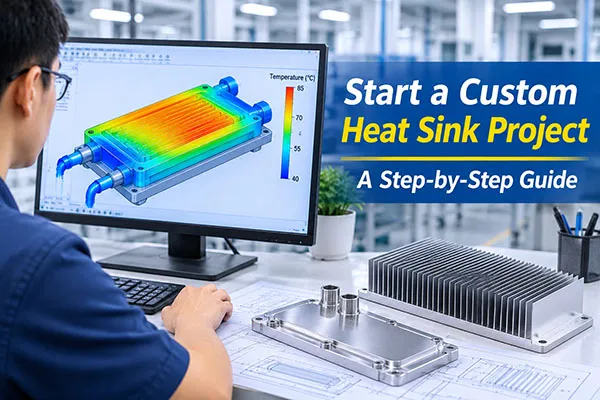
1. Define Your Thermal Requirements
The first step in any custom heat sink project is understanding what needs to be cooled.
Before discussing materials or manufacturing methods, you should identify the heat source, operating environment, and required thermal performance.
Important information includes:
• Heat dissipation power: How much heat must the heat sink remove, measured in watts (W)?
• Operating temperature: What is the maximum allowable temperature of the electronic component?
• Ambient temperature: What temperature will the heat sink operate in?
• Thermal resistance: What thermal resistance is required between the heat source and the surrounding environment?
• Cooling method: Will the product use natural convection, forced air cooling, or liquid cooling?
• Available space: What are the maximum dimensions and installation limitations?
For example, an AI server GPU requires a very different cooling solution from a small LED lighting module. High-power electronics may require vapor chambers, liquid cold plates, or high-density fin structures, while smaller devices may work well with extruded aluminum heat sinks.
Pioneer Thermal Tip: Providing accurate thermal requirements at the beginning helps our engineering team evaluate suitable heat sink structures and manufacturing processes more efficiently.
2. Select material and manufacturing process
Material and process go hand in hand, and both depend on performance targets and volume.
• Aluminum is light, affordable and easy to shape. It is the default for most projects.
• Copper conducts heat much better but is heavier and costs more. It shines at hotspots and compact, high-flux designs.
• Extrusion is economical for straight-fin profiles.
• CNC machining is flexible and great for prototypes and low volumes.
• Skiving creates thin, tall fins from a solid block.
• Bonded or folded fins allow large surface area in a compact volume.
• Cold forging forms dense pin-fin structures in one piece, a strong choice for higher volumes.
• Liquid cold plates combine a machined or forged base with a sealed coolant channel.
Pioneer Thermal tip: the cheapest process at 100 pieces is rarely the cheapest at 100,000. Tell us your expected volume curve up front so we can recommend a process that makes sense now and scales later.
3. Prepare Your Drawings and Technical Specifications
Once the thermal requirements, material, and manufacturing process are defined, the next step is preparing the technical information.
Accurate drawings help the manufacturer evaluate product feasibility, tooling requirements, production methods, and expected costs.
For a custom heat sink quotation, we recommend providing:
• 2D engineering drawings
• 3D CAD files, preferably STEP or IGES
• Overall dimensions and critical tolerances
• Material and surface treatment requirements
• Mounting hole positions
• Fin height, thickness, spacing, and geometry
• Heat source dimensions and power
• Thermal performance targets
• Expected annual production quantity
If you do not have a finalized design, you can also provide product photos, installation dimensions, electronic component specifications, and your initial cooling requirements.
Our engineering team can review the available information and discuss potential design and manufacturing options.
4. Develop a Prototype and Verify Thermal Performance
Before moving into mass production, prototype development is an important step in reducing technical and commercial risks.
A prototype allows engineers to evaluate whether the proposed structure meets the project's requirements.
During this stage, several factors should be checked.
Dimensional Inspection
Critical dimensions, mounting positions, flatness, and fin geometry should be inspected against the engineering drawings.
Thermal Performance Testing
Thermal testing helps determine whether the heat sink can effectively remove heat under specified operating conditions.
Depending on the application, testing may evaluate:
• Temperature distribution
• Thermal resistance
• Heat dissipation capacity
• Airflow or coolant flow performance
• Temperature rise under different loads
Structural and Assembly Verification
The prototype should also be checked for mounting compatibility, mechanical strength, connection reliability, and assembly clearance.
For liquid cold plates, additional testing may include leak testing, pressure testing, and internal cleanliness verification.
Testing conditions should be agreed upon in advance to ensure that the results accurately reflect the actual application.
At Pioneer Thermal, we believe prototype verification is essential for identifying design improvements before investing in mass-production tooling.
5. Optimize the Design for Mass Production
A heat sink that performs well in a prototype does not automatically guarantee efficient mass production.
Design for Manufacturing (DFM) helps ensure that the product can be manufactured consistently, efficiently, and economically.
During DFM evaluation, manufacturers may review:
• Fin thickness and spacing
• Material utilization
• Tooling feasibility
• Machining allowances
• Assembly methods
• Surface treatment
• Manufacturing tolerances
• Production cycle time
For example, an extremely thin fin structure may improve heat transfer area, but it can also increase manufacturing difficulty and the risk of deformation.
Similarly, a complex cooling channel may improve fluid distribution but require additional machining or joining operations.
The goal is to achieve the right balance between thermal performance, manufacturing feasibility, product reliability, and total cost.
Early communication between the customer and manufacturer can significantly reduce unnecessary design changes later.
6. Start Your Custom Heat Sink Project with Pioneer Thermal
At Pioneer Thermal, we understand that every thermal management project has different requirements.
An AI server cold plate, an automotive electronic heat sink, and an industrial power module cooler may all require completely different designs and manufacturing processes.
As a custom heat sink manufacturer, we support customers with a range of thermal management manufacturing solutions, including:
• Aluminum extrusion heat sinks
• Copper and aluminum skived-fin heat sinks
• CNC-machined heat sinks
• Vapor chambers and heat pipe assemblies
• Liquid cold plates
• Customized thermal management components
Our goal is to help customers move from an initial cooling concept to a reliable, manufacturable product.
Whether you are developing a new electronic device, upgrading an existing cooling system, or looking for a manufacturing partner for long-term production, our team can work with you to evaluate the technical requirements and suitable production options.
Ready to start your project?
Send us your drawing, or just your power, temperature and space limits. The Pioneer Thermal team will review it and come back with practical design suggestions and a clear quote.
 +86-152 2030 1231
 E-mail
